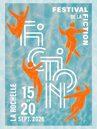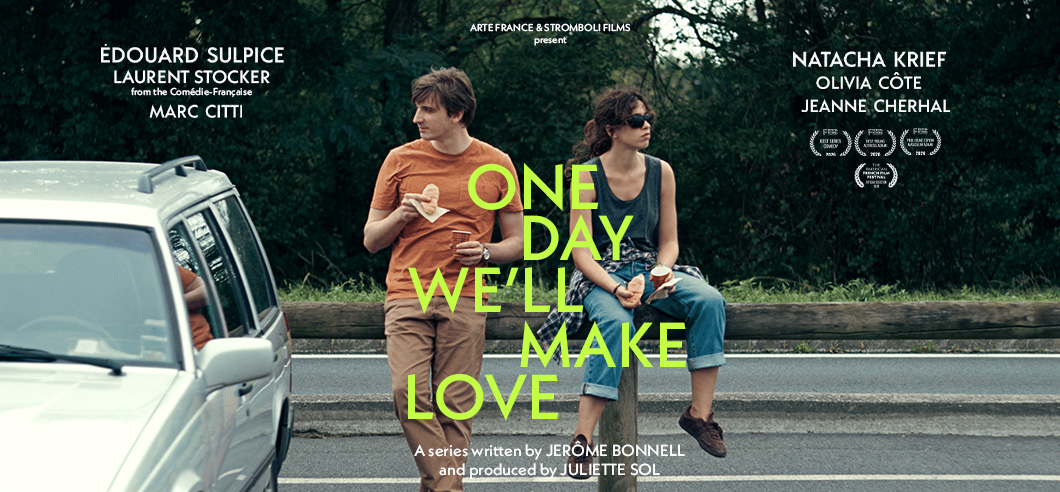

What happens when two people who are complete opposites meet at the wrong time… or perhaps at just the right time? With its sensitive take on love, empowerment, and second chances, One Day We'll Make Love redefines the conventions of the romantic comedy. Directed by Jérôme Bonnell and starring Natacha Krief and Édouard Sulpice, the mini-series—available on ARTE since October 22—has already won over industry professionals by taking home three awards at the Festival de la Fiction de La Rochelle, including Best Series in the Comedy category.
Juliette Sol, a producer at Stromboli Films, and Marie-Laure Hébrard, executive director of Film & Picture, discuss the behind-the-scenes story of this project and its international potential.
Unifrance: How did the project come about? What convinced you to support the series?
Juliette Sol: Jérôme Bonnell is unique in that he develops and writes on his own; he’s a remarkable screenwriter. He showed me the three episodes with dialogue—they were very well written and very expressive. It was easy for me to envision what the series would be like. I’d already worked with Jérôme on his previous TV film, Cheers to Joy; I’ve seen all his films, so I could see where he was going with this.
The mini-series unfolds over three episodes, which chronicle the three days following the encounter between Aurore and Noé, two thirty-somethings who, at first glance, seem to have nothing in common. Did the short format naturally present itself as the best way to tell their story?
J.S.: The series was conceived from the start in three episodes. We debated it a bit, but the narrative and its runtime could only unfold within this format. We were very happy that Arte accepted it as is.
Jérôme Bonnell films his characters with great sensitivity, exploring their quest for emancipation, their physical and emotional vulnerability, as well as their desire for romantic intimacy. They and the situation don't fit the romantic comedy stereotypes. Was it your intention from the outset to refresh the genre's conventions?
J.S.: Yes, absolutely. That was clear from the very first discussions. Jérôme has been taking this tack for a long time—since the beginning, I’d say.
Spanning romance, comedy, a coming-of-age story, and a satire of the bourgeoisie, the series navigates several genres. How was this balance achieved, and how does it contribute to the project’s uniqueness?
J.S.: It's obviously all down to Jérôme's talent; he builds the story layer by layer throughout filming and post-production, working on variations in the actors’ performances between takes, editing, sound, music, and so on. In this way, he constructs a rich, extremely nuanced narrative. I think Jérôme works a lot “by ear” and has a keen sense of what feels right and harmonious.
Natacha Krief and Édouard Sulpice make a particularly compelling duo on screen, thanks to their wonderful chemistry. How did you go about choosing these two very promising actors?
J.S.: Jérôme is a remarkable director of actors. He has a very keen understanding of French actors. He goes to the theater a lot, sees everything, and has a very sure instinct for casting. He reached out to Natacha Krief and Édouard Sulpice, whose work he was familiar with. They auditioned together—performing a scene from Episode 1—and the decision was made very quickly.
Selected for several festivals, the series notably won three awards at the Festival de la Fiction de La Rochelle, including Best Series in the Comedy category. Did you expect such a warm reception, both from industry professionals and the press?
J.S.: Even though we had three awards for Cheers to Joy, in 2023, we weren’t expecting anything in particular. We simply knew that the series matched what we’d envisioned when we first read the scripts. We hoped it would be seen and loved, and it’s truly heartwarming to see that it has been.
Marie-Laure Hébrard: At the screening in La Rochelle, the audience’s reception was fantastic. It was a good omen for any awards the series might win. However, I didn’t expect this many.

Following its premiere on ARTE, which gives it visibility in France and across Europe, what are your plans for the series’ international distribution?
M.-L.H.: Film and Picture will, of course, reach out to the same buyers who acquired Jérôme Bonnell’s previous film, Cheers to Joy, in Japan and Germany. Next, we’ll pitch the series to pay-TV providers, streaming platforms, and public broadcasters—our regular clients around the world. The 3x52’ format can sometimes pose a challenge in certain markets, but experience has shown us that it isn’t always an obstacle. The press reception in France has been excellent, and we’ll be sharing that with our clients. The fact that the series is both funny and irreverent brings a breath of fresh air to a market oversaturated with crime dramas. I’m very confident about the series’ international potential, especially given the awards it has won.
.