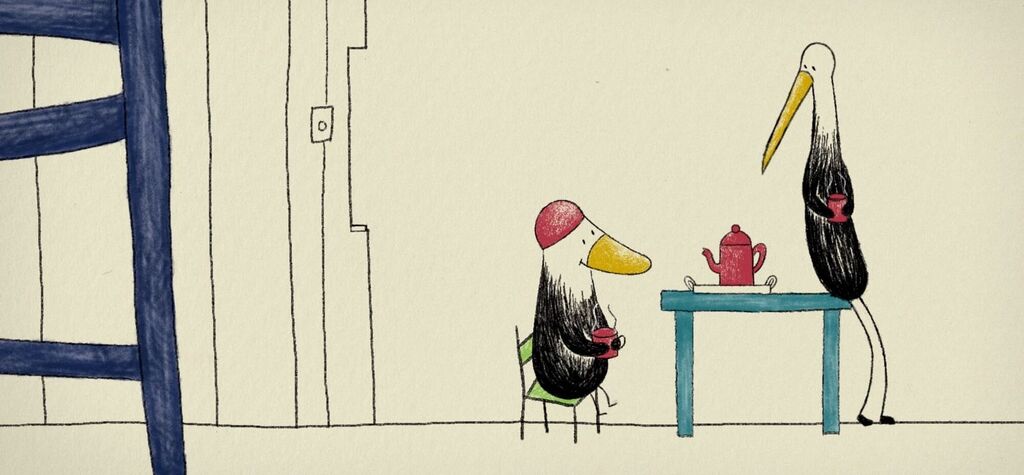
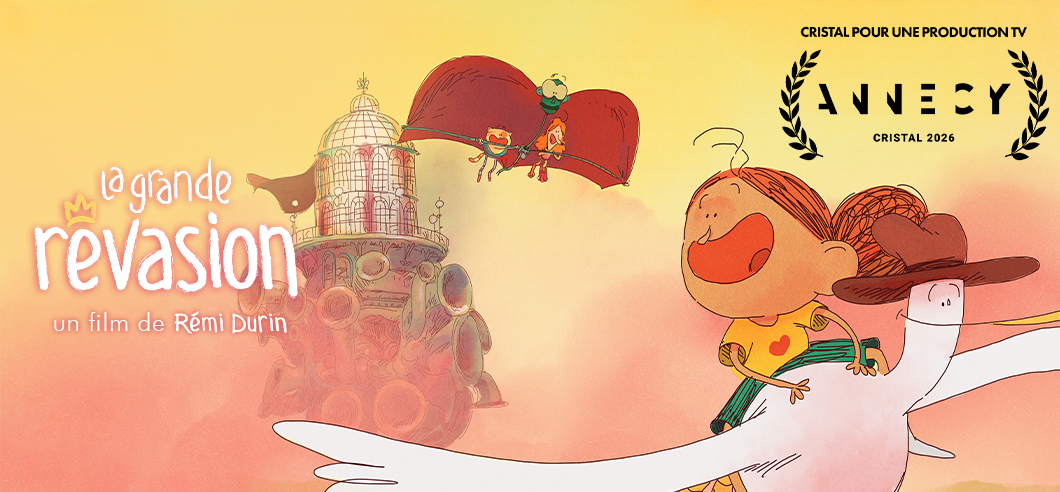

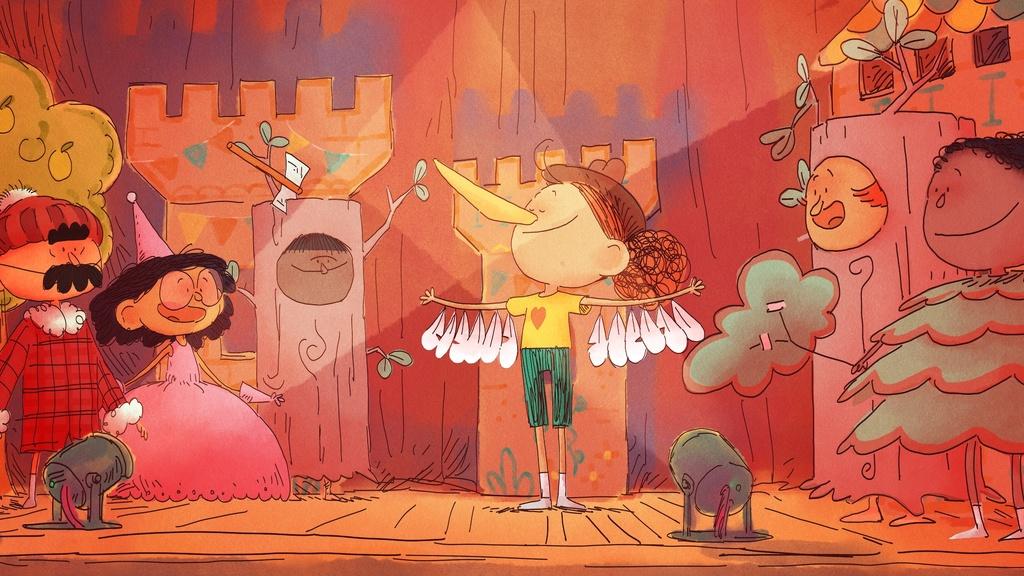
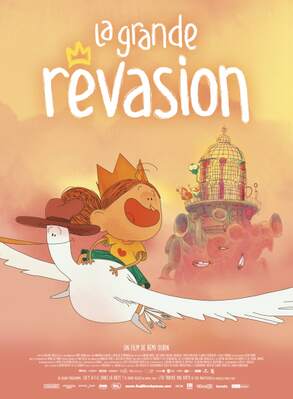
A blend of coming-of-age tale and adventure story, The Great Dreamscape transports viewers of all ages into a world where imagination becomes a way to overcome fears and embrace the unknown. Just as she is about to take the stage for her school play, young Andréa, paralyzed by anxiety, takes refuge behind a mysterious cape that carries her away to a fantastical world filled with unexpected discoveries.
Awarded the Cristal for a TV Production at the Annecy International Animation Film Festival, this short film produced by Autour de Minuit and Kwassa Films, and distributed internationally by Autour de Minuit, which was drawn to its unique visual style, humor, and eclectic soundtrack. Already airing on CANAL+ in France, it will soon be available in Switzerland and Canada.
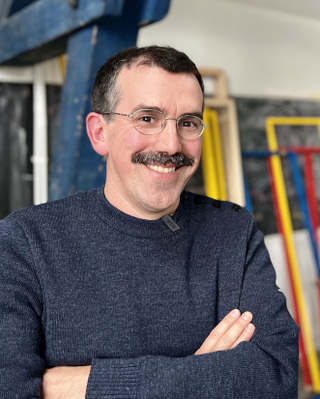
In this interview, director Rémi Durin and producer and distributor Nicolas Schmerkin, founder of Autour de Minuit, discuss the project’s origins, the artistic choices that shaped the film, and their ambitions for its international release.
Unifrance: Can you tell us about how this project came about and how the various collaborators met?
Rémi Durin: The film arose from an initiative of Valérie Magis, who wrote the screenplay. Although the final project bears little resemblance to its initial version, Valérie was its driving force from the very beginning. I joined her, contributing ideas and creative visions that she incorporated into a script that was constantly evolving.
The writing process for the film thus lasted nearly three years. The final rewrite took place during the animation phase, when the film truly begins to exist as a cinematic work and narrative challenges arise and are resolved in a cinematic way. Many elements, including the dialogue, were then revised and reimagined.
Like a children’s story, the film explores a universal, transgenerational anxiety: the fear of oneself, of the unknown, but also of others. Did you want to convey a positive message about the importance of dreaming, taking risks, and experimenting—one with multiple layers of meaning, intended for both children and adults?
RD: Of course, fear is part of all of us; it’s personal to each of us and, at the same time, universal. In a way, dreaming gives us access to aspects and hidden corners of ourselves or the world that these fears prevent us from grasping.
One of life’s great challenges, especially during childhood, is learning to overcome these fears in order to access parts of the world—or of ourselves—that seem out of reach. Today, at over 40 years old, I still don’t have access to everything, and many of my fears are still in control. So this film moves me almost as much as it would a young child.
The visual style brings a touch of humor, lightness, and spontaneity to the film, particularly through its “sketch-like” aesthetic. Could you elaborate on this artistic choice and how it serves the narrative?
RD: With each of my films, I like to experiment with a new visual approach. For this one, I wanted a lively, dynamic, vibrant—almost pulsating—line to give the characters and the world a unique energy and expressiveness. I greatly admire illustrators such as Quentin Blake and Bernadette Després, whose drawings are remarkably spontaneous and fresh.
Marie de Monti, a comic book artist whose work I greatly admire, helped me create the characters, infusing them with their visual quirkiness, while I focused on the film’s settings and colors.
The film’s music seems to draw some of its inspiration from jazz and echo its message of freedom. What were the main musical influences, and how was the soundtrack conceived?
RD: At first, we wanted to contrast two styles of music: classical and jazz. In the end, that felt rather reductive, very basic, and not very relevant. Admittedly, jazz evokes the image of spontaneous, improvised music, free from overly strict or academic constraints. However, we quickly realized that we should instead imbue the characters and settings with a rhythmic identity of their own.
Together with Yan Volsy, the composer, we explored several different directions—very eclectic in terms of genre—without trying to make things logical or formulaic. It was actually very intuitive, like a gut feeling. The first musical demo we created really went in all directions. One thing was certain, though: I wanted that percussion solo to explode just as Andréa and the bird destroy the machine, introducing off-beats.
In that sense, it was liberating music, capable of provoking a reaction from the characters.
This year, the film won the top award in its category at the Annecy International Animation Film Festival: the Cristal for a TV Production. What are your international ambitions moving forward? In your opinion, what are the film’s main strengths that will appeal to international festivals, distributors, broadcasters, and audiences?
Nicolas Schmerkin: The Great Dreamscape is a film that invites children (and adults) to accept, feel, and use their fears as a source of strength. It features a strong and unique visual style, which has allowed it to compete at the world’s leading animation festivals—with great success so far (Anima, Clermont-Ferrand, Annecy, Rennes, Vila Do Conde, Anibar…).
Driven by a universal narrative blending adventure and comedy, as well as charismatic and endearing characters, it is an ideal film for broadcast on international television networks. In France, it is broadcast by Canal+, and it was recently acquired by RTS in Switzerland and by TFO in Canada.
For theatrical releases, it is also accompanied by other short films. This is the approach taken by Les Films du Préau in France, where the film has already drawn more than 60,000 viewers, and by Le Parc Distribution in Belgium, which began screening it this week.
Alongside its festival run, the film is being pitched to major television networks and streaming platforms around the world, with the hope that, like Andréa, it too will take flight on the international stage!
Media Gallery
In connection with this news
Movies(1)
Events(1)
Annecy International Animation Film Festival - 2026
Feature film and short film festival
France
from
to