


Les Miserables
Synopsis
The bishop's background is briefly sketched rather than detailed as in the novel. Javert is a young boy, the son of a guard in the Toulon prison, when he sees Valjean as a convict. Sister Simplice admits Valjean and Cosette to the convent instead of Father Fauchevent. Thénardier, in disguise, meets Marius and proves to him with the help of newspaper clippings that he is completely mistaken about Valjean's criminal past.
Source : Wikipedia
Credits
Director (1)

Actors (64)








Production and distribution (3)
- Executive Producers : Production Artistique et Cinématographique (PAC), Pathé Production
- Foreign production companies : DEFA - Studio Babelsberg, Serena Film
- Film exports/foreign sales : Pathé Films
Full credits (20)
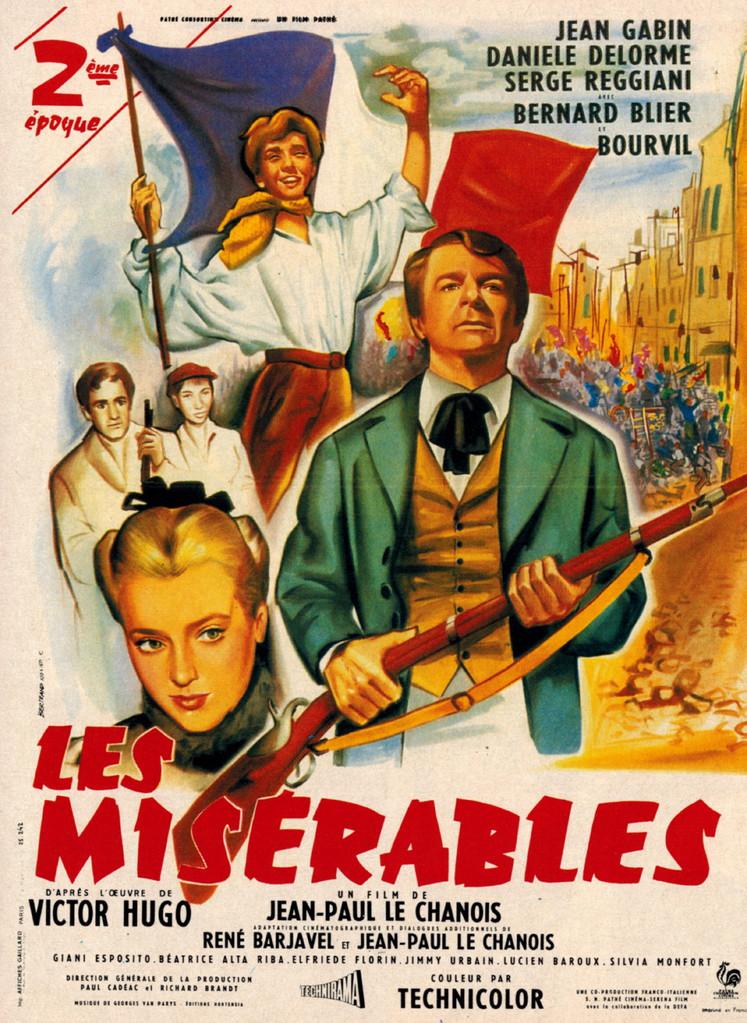
- Adaptation : Jean-Paul Le Chanois, Michel Audiard, René Barjavel
- Screenwriters : Jean-Paul Le Chanois, Michel Audiard, René Barjavel
- Dialogue Writers : Jean-Paul Le Chanois, Michel Audiard, René Barjavel
- Director of Photography : Jacques Natteau
- Music Composer : Georges Van Parys
- Editor : Emma Le Chanois
- Sound Recordist : René-Christian Forget
- Costume designers : Marcel Escoffier, Frédéric Junker
- Author of original work : Victor Hugo
- Producers : André Hunebelle, Adrien Remaugé, Pierre Cabaud, René Bezard
- Sound Assistant : René Sarazin
- Assistant Operators : Jacques Lacourie, Max Lechevallier
- Camera operators : Henri Tiquet, Alain Douarinou
- Production managers : Louis Duchesne, Paul Cadéac
- Assistant Editor : Jacqueline Aubery
- Continuity supervisor : Geneviève Cortier
- Production Designer : Serge Pimenoff
- Narrator : Jean Topart
- Still Photographer : Roger Corbeau
- Location Manager : Jean Feix
Watch this movie
Watch Les Miserables in VOD
| Platforms | Model | Price | Quality |
|---|
Sorry, your search returned no results.
| Platforms | Model | Price | Quality |
|---|
Sorry, your search returned no results.
| Platforms | Model | Price | Quality |
|---|
Sorry, your search returned no results.
| Platforms | Model | Price | Quality |
|---|
Sorry, your search returned no results.

Media Gallery
Technical details
- Type : Feature film
- Genres : Fiction
- Sub-genre : Literary adaptation , Drama
- Themes : Fate
- Production language : French
- Coproducer countries : Germany, Italy, France
- Original French-language productions : Yes
- Nationality : Majority French (Germany, Italy, France)
- Production year : 1958
- French release : 12/03/1958
- Runtime : 3 h 37 min
- Current status : Released
- Visa number : 15430
- Visa issue date : 04/03/1958
- Approval : Yes
- Production formats : 35mm
- Color type : Color
- Aspect ratio : CinemaScope
- Audio format : Mono
Box-office & releases
TV broadcasting
This content is for registered users only.
Are you a member? Please login to view content.
News & awards
Selections (1)

About
Production
Called "the most memorable film version", it was filmed in East Germany and was overtly political. Of the many film adaptations of the novel, this has been called "the one most popular with audiences in postwar France". One noteworthy plot change was made to accommodate the fact that the actors playing the roles of Valjean and Javert were far apart in age, rather than near contemporaries as in the novel. Instead of Javert recognizing Valjean as a convict he had often guarded years earlier, he remembers how, when he was just a boy, his prison guard father had pointed out this man as "the worst kind of prisoner, who tried to escape four times".
Release
The New York Times described it as one of the first French "blockbusters" that appeared in response to such lengthy feature films as Around the World in 80 Days and The Ten Commandments. It said it was "a ponderous four-hour retelling of Victor Hugo's oft-filmed epic.... Not a page is skipped... Too literary, it has the saving grace of Jean Gabin's truly heroic depiction of Jean Valjean plus some stirring scenes on the barricades." It was a "quintessential Gabin role ... that of a loner, an outsider, usually a member of the lower orders who may flirt with love and happiness but knows they are not for him".
The film did not premiere in New York until July 1989, when it ran to coincide with the celebration of the bicentennial of the French Revolution.
Source : Wikipedia